On the gap between can and should.
I’ve just got back from Barcelona. My partner is a big Gaudi fan and has wanted to go for years. I was, if I’m honest, a little ignorant about his work going in. I came back converted.
The buildings are extraordinary in a way that photos don’t quite prepare you for. Casa Batlló. Casa Milà. Park Güell. Sagrada Família. The way his work makes everything nearby look like it was built by someone who gave up. What got me was the quality of the detail, the sense that everything organic and colourful and playful had grown rather than been designed. We both came home wanting the world Gaudified.
My first thought, genuinely, was: I wish AR glasses would hurry up. I wanted a pair I could put on and just have everything I looked at transformed in real time. Buildings, streets, the car in front at the traffic lights. All of it. Obviously that’s a few years away at minimum, and probably longer before it’s anything other than a novelty. So I scaled back.
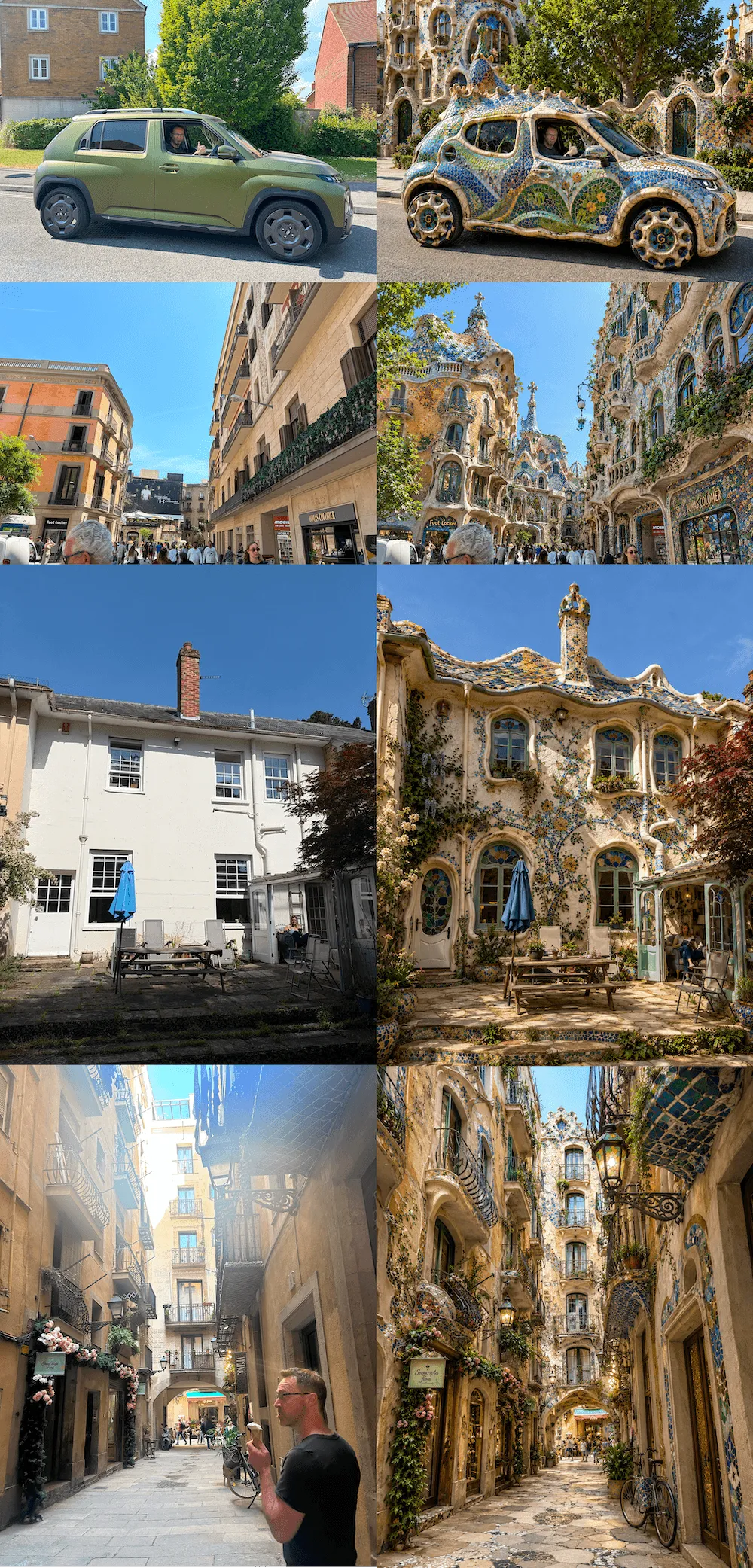
What if you could take a photo of any building or street and see what it might look like if Gaudi had been the architect? A camera app. Point it at anything and get a glimpse of the world it could have been.
I ran some tests. A couple of ordinary Barcelona side streets. A car I’d been test driving. The back of our house. The results were genuinely lovely. Surfaces suddenly covered in mosaic and ceramic tile, windows turned into something that looked like it had grown from stone. It worked, in the sense that it produced exactly what I imagined.
And then I didn’t build it.
Not because I couldn’t. That’s the strange thing about the moment we’re in. The tooling is good enough that I could probably have a working prototype by the end of a weekend. A year ago that wasn’t true. Now it just is, and the constraint has shifted somewhere else.
Here’s where I got stuck. Every image transformation like this costs something. It runs on remote servers, burning electricity, at a scale that individual users can’t see and most don’t think about. For a utility you’d weigh that against the value it creates. But a camera that turns your surroundings into Gaudi? It’s fun. It’s a bit of a toy. Is that enough to justify the compute?
I know the obvious counter-argument, because I was already making it to myself. This is the same logic we’ve been fed for twenty-odd years on environmental issues. Do your bit. Shorter showers. Recycle. All while watching industries, fossil fuels especially, abuse everything they touch with near-total impunity. Our collective impact as individuals amounts to a fraction of what one bad actor does in a week.
Accidental Tech Podcast episode 692 talked about how data centres are being rushed in across America without care for environmental impact, burning gas when they could be running on renewables and recycled grey water. Built with care, they could be close to a net positive. Built the way many of them are being built right now, they’re just gross. My individual restraint changes essentially nothing in the face of that.
The recycling argument works because you’re changing how you handle something you’d be doing anyway. A Gaudi camera creates demand that didn’t exist. It’s not a more efficient version of something I’d be doing regardless. It’s a new thing, justified mainly by the fact that it’s now possible to make it.
And that’s the question I keep coming back to. Just because you can build something easily now, does that change whether you should?
I don’t think the answer is always no. Ease is a good thing. Barriers to creation being lower means more things get made that are worth having. But it probably means the question needs to become more deliberate, not less. The friction of difficulty used to do some of the filtering.
Now the filter has to be you.
Maybe the version of this I could feel better about is one where the processing happens entirely on device. No data leaving your phone, no remote servers, no energy cost beyond what’s already in your pocket. I’m not aware of anything that could do this well enough right now. But if that changes, maybe the Gaudi camera becomes an easier yes.
For now it stays in the ideas folder. I just want to make sure I’m making that call, rather than defaulting to yes because yes got cheaper.
The environmental cost isn’t the only thing I couldn’t quite square. There’s something still uncomfortable about how a model learns Gaudi’s style. I can’t know if it was from public domain images. He died a hundred years ago so nobody owns his style, and style isn’t easily copyrighted. But legal and honourable aren’t always the same question. Gaudi spent his life on these buildings. Using that as raw material for a phone camera filter feels like something worth at least acknowledging, even if I can’t tell you exactly where the line is.